Hofstede’s cultural dimensions theory is a framework of cross-cultural communication developed by Professor Geert Hofstede, Gert Jan Hofstede, Michael Minkov and their research teams. The professor defines cultured as “the collective programming of the mind distinguishing the members of one group or category of people from others”. Therefore culture could be interpreted as a collective identity that allows us to differentiate groups, cities, nations. This collective identity shapes our personalities and the way we behave and communicate with others.
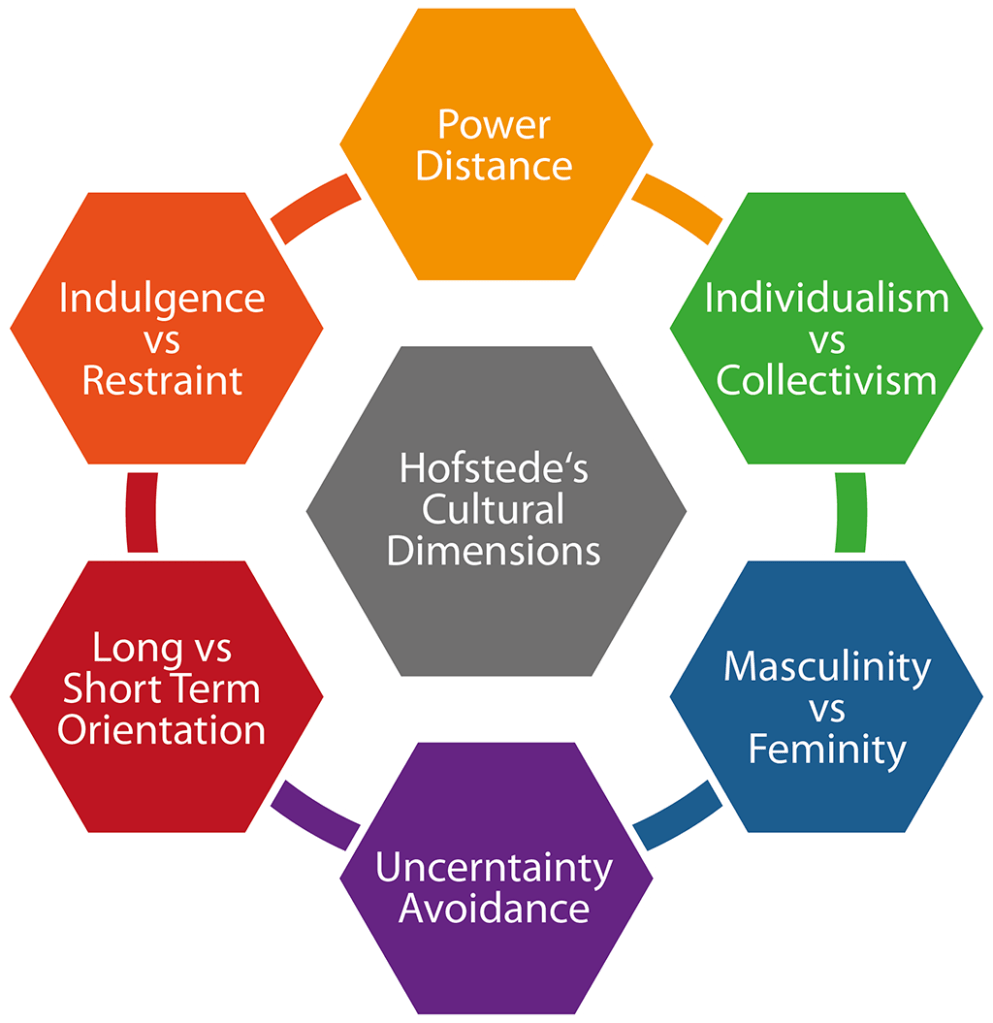
This model consists in the analysis of countries -therefore it refers to national culture- on the basis of six dimensions that show how values on the workplace are influenced by a society’s culture.
The cultural dimensions represent independent preferences for one state of affairs over another that distinguish countries (rather than individuals) from each other. It is important to keep in mind that the dimensions results are rather relative, as we’re all human and unique. This means that the dimensions can only be properly interpreted if they’re compared. In fact, the data collected by the professor was obtained through the comparison of over 70 countries around the world.
The research is used worldwide in the academic and the professional spheres, given the accuracy of its results. The importance of the dimensions relies on its capacity to illustrate the differences and similarities between cultures, giving people a better approach to cultures that may seem far away for them but are closer than it looks, or vice versa.
Using Hofstede’s dimensions to compare cultures: Colombia and South Africa
According to Hofstede Insights colombian and south african culture, regarding the six dimensions, are relatively similar. The website, however, states that the results in South Africa refer to the white population, which means the comparison is not entirely accurate.
As we can see in the chart, 3 of the six dimensions show similar results, however the rest of them have very different scores. We will, moreover, analyze what these results mean in terms of cultural behavior and national identity.


Power Distance: according to Hofstede’s theory, this dimension deals with the fact that all individuals in societies are not equal – it expresses the attitude of the culture towards these inequalities amongst us. Colombia (67/100) scored higher than South Africa (49/100), meaning that colombians often feel inequalities are just a fact of life, something natural. South african, on the other hand, accept less the distribution of power. However, both cultures deal with a hierarchical society that concentrates power in a few hands. Colombia accepts more the hierarchical order in which everybody has a place and, therefore, needs no justification.
Cultures with a lower score tend to strive towards equality and Colombia has a long history of remaining silent at social injustices, including the distribution of power. However, as this model is not static and the results can change over a year, we are now facing a new wave of protests and nonconformity with the social order in the country that could lead to the transformation of this dimension.
Individualism: this dimension is related to the definition of people’s self-image in terms of “I” or “We”. According to the chart, Colombia (13/100) is rather a collective nation. People in here will mostly belong in groups that take care of them in exchange for loyalty, and vice versa.
On the other hand, South Africa (65/100) is a country with a high level of individualism, meaning family or other small, exclusive groups, are a key element in their culture. They look after themselves and their family. This actually relates to their historical reference to tribes as families in the beginning of their society. They rely on very few people because they consider their close ones the most important.
Colombians, on the contrary, tend to expand their circle beyond family: creating bonds with their neighbors, their classmates, their colleagues, their ideological groups. In fact, colombians feel very deeply about their roots, they have a collective mindset regarding national identity, they defend their country as if it was their family because it is, somehow, their family.
The implications of this dimension affect the way colombians and south african behave towards nationalism, for instance. Looking after your important ones can be really different when you see them as, virtually, every citizen of your country, or just your family.
Masculinity: both countries scored a high level of masculinity (Colombia 64/100 and South Africa 63/100), meaning their cultures are based on competition, achievement and success. If they had scored lower, they’d be represented by Femininity, which stands for a preference for cooperation, modesty, caring for the weak and quality of life: a society consensus-oriented.
However, both countries seek material rewards for success, positioning themselves away from altruism. We see that both countries thrive on economic growth and, on the individual level, seek a life that’s full of cars, houses and other people’s approval to find happiness.
Uncertainty Avoidance: this dimension refers to the way in which a society deals with the fact that the future can never be known. Colombia (80/100) scored high, which means they are not comfortable with such ambiguity. This may be related to the strong religious roots that the country has, reflecting their need to seek answers, specially about the future. They care about consequences and punishment and therefore have a lot of rules.
On the contrary, South Africa (49/100), according to its score, has a more relaxed attitude in which practice counts more than principles and deviance from the norm is more easily tolerated. They can accept the uncertainty and live with it better than colombians.
Long term orientation: both countries scored low on this dimension (Colombia 13/100 and South Africa 34/100), which means they have to strongly maintain links with their past as they face the challenges of the future, often wanting to remain in the past by relying on norms to avoid societal change.
Full of time-honored traditions, Colombia is one of the most conservative cultures there is. Change is not well accepted, something that has costed this culture even an armed conflict. South Africa tends to be more pragmatic than Colombia, but maintains doubt towards change.
This dimension is also strongly related to uncertainty avoidance, in terms of rules: countries that score lower in the previous dimension tend to have a lot of rules in their society. The rules give societies safety regarding the future: the more they rely on them, there will be lesser efforts to modernize/change the societal structure and so the present circumstances won’t change and the uncertainty is lower.
Indulgence: this dimension is defined as the extent to which people try to control their desires and impulses, based on the way they were raised. Both countries scored high (Colombia 83/100 and South Africa 63/100), meaning they have weak control over this. People in societies classified by a high score in Indulgence generally exhibit a willingness to realise their impulses and desires with regard to enjoying life and having fun.
The colombian mothers are rather indulgent toward their children: they let them play and have fun as they please. As a consequence, this society has a tendency towards optimism and leisure time plays an important role for them. This also applies to south african culture.
In conclusion
Colombian culture is very similar to a lot of other Latin American countries, with a few special elements that make it unique. As we look at Colombian history, for example, we can identify the influence left by the Spanish colonial era throughout the country, with a high rate of Roman Catholics in Colombian society and the remainings of hierarchical structures that characterized spanish colonies. On the other hand, the Spanish decimated the indigenous population here, yet many elements live on in Colombian customs, music, and language.

South Africa has been famously referred to as the rainbow nation because it is made up of so many diverse cultures and religions. Contained within South Africa’s borders are Zulu, Xhosa, Pedi, Tswana, Ndebele, Khoisan, Hindu, Muslim, and Afrikaner people to name but a few. The results of the model refer only to the white south africans, which represent a small percentage of the population. It is, therefore, necessary to broaden the scope of the research to other cultural models or even specific analysis that take into account the vast diversity of this country.
 Traveling guide to South Africa