As we have seen throughtout this blog, culture is not an exact formula, but rather a wide range of behavior and customs. Therefore, is not a surprise that inside cultures there are smaller groups that have their own identity, values and practices, often related to youth, gender, sexuality, social class, nationality or religion (Venter & Johnsone, 2012). Subcultures are often marginalized and some authors argue that they are meant to resist dominant hegemonic cultural values in which they are involved (Williams, 2007).
In South African culture there are numerous subcultures that intend to express statements in many ways. In this post we’ll explore two of them, as well as one tribe that currently exists in the country.
Skhothanes They use style and fashion as a way to express themselves. The word Skhothanes means «to boast» in Zulu (a traditional south african language). They often show their extravagant clothes, always mentioning the brand and price of each item. Their message is portrayed a way for young south africans to move up in a society that offers them few options (Sprinks, 2014).
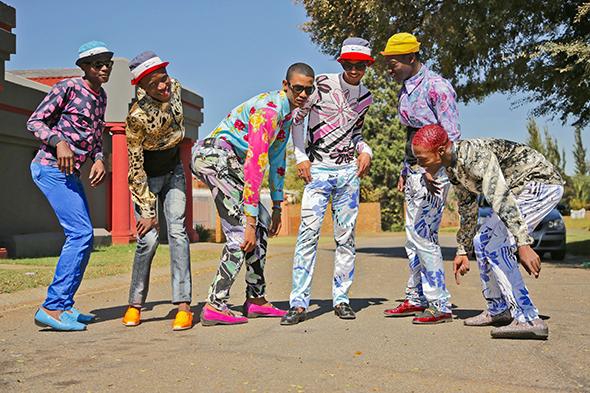
Smarteez The Smarteez are a small youth group of fashion designers who dress in bright and mismatching colours and patterns to make their statement. Their belief is that they’re born to be free and so they will express that by wearing what they want and drawing attention to themselves in the meantime. The oppose the tradition and mainstream culture (Venter & Johnsone, 2012). They are located in metropolis where they feel less judged.
Here’s a video that shows more of the Smarteez subculture and their behavior:
People worth watching: the Smarteez from Johannesburg.
ZULU: A TRIBE
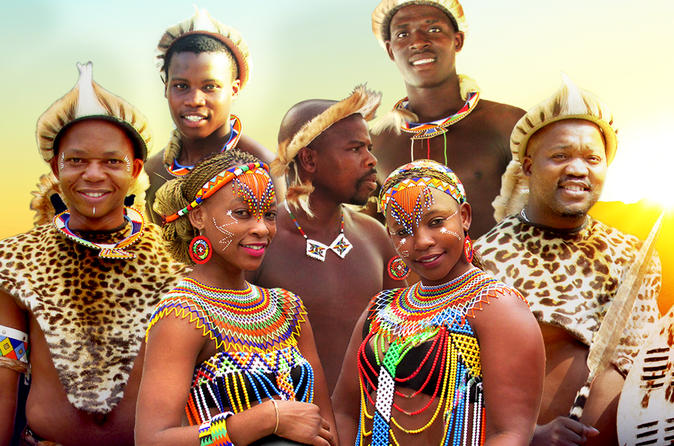
This is the largest ethnic group in South Africa, with over 10 million people. They refer to themselves as ‘the people of the heavens’. The speak IsiZulu, which is South Africa’s most widely spoken official language. It is a tonal language understood by people from the Cape to Zimbabwe and is characterized by many “clicks”. In the 19th century they merged into a great kingdom under the leadership of Shaka. The legend tells Shaka accepted the leadership of the clan, who at the time only consisted of 1500 people, from his father. Through military tactics he defeated the enemy. However, after his mother died he lost his mind and hilf halg-brothers assassinated him as he became a threat for his clan (he had hundreds of Zulu killed during his period of grief). Traditional Zulu religion was based on ancestor worship and on beliefs in a creator god, witches, and sorcerers. Modern Zulu Christianity has been marked by the growth of independent or separatist churches under prophets, some of great wealth and influence. They live mainly in the province of KwaZulu-Natal. There are approximately 10 million Zulu residents, according to the Kruger National Park. Gender roles are sharply shown through clothes: women dress according to their marital status. A single woman wears skirts to show her body, while a married woman covers it to indicate she is «taken». Men don’t change the way they dress according to this. As many tribes, they have traditional beverages such as Amazi and Beer; traditional food, which is mainly vegetarian; and traditional dances that are essential to Zulu celebrations, for example the hunting dance symbolizes the bravery it requires to hunt.
The Lewis Model was developed in the 1990s by Richard D. Lewis after visiting 135 countries and working in more than 20 of them. He came to the conclusion that humans can be divided into 3 clear categories, based not on nationality or religion but on behavior. He named his typologies Linear-active, Multi-active and Reactive.
Lewis considered that other experts (such as Hofstede, Edward Hall, Kluckholn or Trompenaars) overlooked or ignored the powerful Asian mindset (comprising, in fact, half of humanity). He visited many asian countries and decided to locate them in the reactive typology.
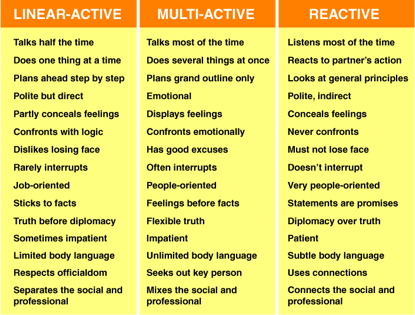
Characteristics of the cultural types.
The characteristics of each typology are shown in the chart. The descriptions are clear and succinct. Linear-actives are those who plan, schedule, organize, pursue action chains, do one thing at a time. Multi-actives those lively, loquacious cultures that do many things at once, planning their priorities not according to a time schedule, but according to the relative thrill or importance that each appointment brings with it. And reactives are those cultures that prioritize courtesy and respect, listening quietly and calmly to their interlocutors and reacting carefully to the other side’s proposals.
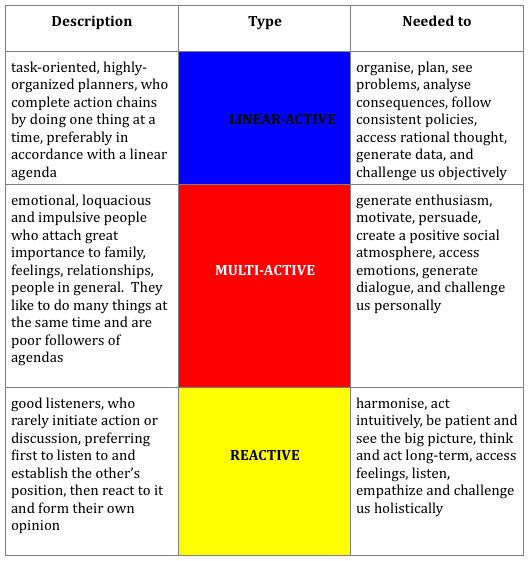
We need each other.
One could say this model allows us to understand our behavior, but mostly our strengths and weaknesses. As we can see in the second chart, the model does not intend to use the typologies to exclude certain cultures but rather take advantage of their strengths, using them wisely. This model is often used in Human Resources because it comprises the factors that must be taken into account for a job. In order to do so, the company can run an individual test to know the affinity of their behaviour with other countries and also their similarity to or deviation from their own national norm. It can also be applied in groups to know compatibility of the people tested.
The comparison
In the following chart is presented the tripartite model, in which can be located both countries that are being analyzed in this blog: Colombia and South Africa.
As it is shown, Colombia is located, next to other south american countries (and Italy) as a multi-active culture, and as the chart specificies it is a warm, emotional, loquacious and impulsive culture. South Africa, on the other hand, is next to Belgium and Israel, right in the middle between the linear-active and multi-active cultures. In order to analyze it we must look into both categories.
Regarding South Africa it is important to keep in mind the lack of data in terms of diversity. In this model the prevalence of white population’s preferences in the results, instead of threating the analysis, reminds us the limits that come with these kind of models, which try to understand behavior as a whole but fail to consider the complications inside a group full of «similar» people.
Having said that, and remembering the descriptions in the previous charts, the analysis is presented in the following chart:
Colombia
South Africa
Displays feelings
Sometimes displays feelings, but mostly conceals them
Emotional, loquacious and impulsive, which can be noted in the Hofstede’s model in the indulgence dimension (in which Colombia scored high)
Task-oriented, they tend to organize their job. However they enjoy leissure time and sometimes are impulsive, as they scored high in the indulgence dimension of the Hofstede’s model
Great importance to family, feelings, relationships and people in general, noted in the Hofstede’s model in the individualism/collectivism dimension (in which Colombia scored low – collective nation)
Collectivists on a lesser exent but protective of their close ones (families or exclusive groups)
Poor agenda followers
Good agenda followers
It needs to be noted that South Africa is located in the same group as european countries and the United States. This may be to the fact that their culture has been highly westernized and also the prevalence of white population’s preferences in the model. It still reflects the power and influence that its previous colonies had over it.
Hypothetical situation
A person from South Africa that came to Barranquilla would fit well because of the significance that family has for both cultures. However, if this person came to study and would have to do a group project, they would probably face some issues. For instance, Colombia is a multi-active nation, which means we are generally poor followers of agendas so that would be a problem. On the other hand, the fact that South Africans are such good decision makers according to the Lewis Model, would improve the group’s performance.
If this person is someone that does one thing after the other could face limitations as colombians often do many things at the same time. This could be a problem in a group project or even in the classroom, as the techniques used by the teachers are probably influenced by this mindset.
However, it is important to take into account that the model refers mostly to the westernized and white population of South Africa. The circumstances could change if it was someone from a tribe, for example.
In conclusion, the situation wouldn’t be terrible, both cultures are not that different (according to this model). But education styles could be a problem. Given the importance of communication in both cultures, it is surely something that can be talked over.
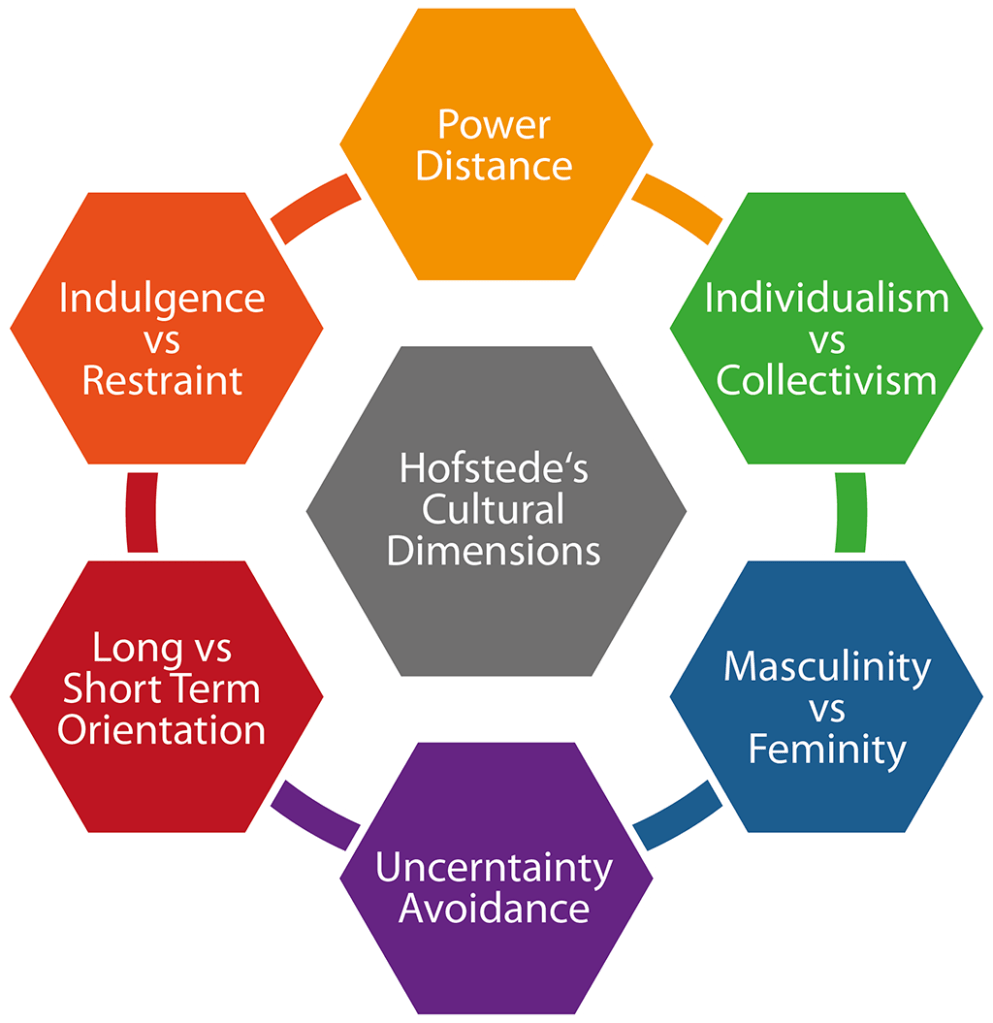
Hofstede’s cultural dimensions theory is a framework of cross-cultural communication developed by Professor Geert Hofstede, Gert Jan Hofstede, Michael Minkov and their research teams. The professor defines cultured as “the collective programming of the mind distinguishing the members of one group or category of people from others”. Therefore culture could be interpreted as a collective identity that allows us to differentiate groups, cities, nations. This collective identity shapes our personalities and the way we behave and communicate with others.
Hofstede’s cultural dimensions
This model consists in the analysis of countries -therefore it refers to national culture- on the basis of six dimensions that show how values on the workplace are influenced by a society’s culture.
The cultural dimensions represent independent preferences for one state of affairs over another that distinguish countries (rather than individuals) from each other. It is important to keep in mind that the dimensions results are rather relative, as we’re all human and unique. This means that the dimensions can only be properly interpreted if they’re compared. In fact, the data collected by the professor was obtained through the comparison of over 70 countries around the world.
The research is used worldwide in the academic and the professional spheres, given the accuracy of its results. The importance of the dimensions relies on its capacity to illustrate the differences and similarities between cultures, giving people a better approach to cultures that may seem far away for them but are closer than it looks, or vice versa.
Using Hofstede’s dimensions to compare cultures: Colombia and South Africa
According to Hofstede Insights colombian and south african culture, regarding the six dimensions, are relatively similar. The website, however, states that the results in South Africa refer to the white population, which means the comparison is not entirely accurate.
As we can see in the chart, 3 of the six dimensions show similar results, however the rest of them have very different scores. We will, moreover, analyze what these results mean in terms of cultural behavior and national identity.
Hofstede’s cultural dimensions. Colombia (blue) and South Africa (purple).
Power Distance: according to Hofstede’s theory, this dimension deals with the fact that all individuals in societies are not equal – it expresses the attitude of the culture towards these inequalities amongst us. Colombia (67/100) scored higher than South Africa (49/100), meaning that colombians often feel inequalities are just a fact of life, something natural. South african, on the other hand, accept less the distribution of power. However, both cultures deal with a hierarchical society that concentrates power in a few hands. Colombia accepts more the hierarchical order in which everybody has a place and, therefore, needs no justification. Cultures with a lower score tend to strive towards equality and Colombia has a long history of remaining silent at social injustices, including the distribution of power. However, as this model is not static and the results can change over a year, we are now facing a new wave of protests and nonconformity with the social order in the country that could lead to the transformation of this dimension.
Individualism: this dimension is related to the definition of people’s self-image in terms of “I” or “We”. According to the chart, Colombia (13/100) is rather a collective nation. People in here will mostly belong in groups that take care of them in exchange for loyalty, and vice versa. On the other hand, South Africa (65/100) is a country with a high level of individualism, meaning family or other small, exclusive groups, are a key element in their culture. They look after themselves and their family. This actually relates to their historical reference to tribes as families in the beginning of their society. They rely on very few people because they consider their close ones the most important. Colombians, on the contrary, tend to expand their circle beyond family: creating bonds with their neighbors, their classmates, their colleagues, their ideological groups. In fact, colombians feel very deeply about their roots, they have a collective mindset regarding national identity, they defend their country as if it was their family because it is, somehow, their family. The implications of this dimension affect the way colombians and south african behave towards nationalism, for instance. Looking after your important ones can be really different when you see them as, virtually, every citizen of your country, or just your family.
Masculinity:both countries scored a high level of masculinity (Colombia 64/100 and South Africa 63/100), meaning their cultures are based on competition, achievement and success. If they had scored lower, they’d be represented by Femininity, which stands for a preference for cooperation, modesty, caring for the weak and quality of life: a society consensus-oriented. However, both countries seek material rewards for success, positioning themselves away from altruism. We see that both countries thrive on economic growth and, on the individual level, seek a life that’s full of cars, houses and other people’s approval to find happiness.
Uncertainty Avoidance:this dimension refers to the way in which a society deals with the fact that the future can never be known. Colombia (80/100) scored high, which means they are not comfortable with such ambiguity. This may be related to the strong religious roots that the country has, reflecting their need to seek answers, specially about the future. They care about consequences and punishment and therefore have a lot of rules. On the contrary, South Africa (49/100), according to its score, has a more relaxed attitude in which practice counts more than principles and deviance from the norm is more easily tolerated. They can accept the uncertainty and live with it better than colombians.
Long term orientation: both countries scored low on this dimension (Colombia 13/100 and South Africa 34/100), which means they have to strongly maintain links with their past as they face the challenges of the future, often wanting to remain in the past by relying on norms to avoid societal change. Full of time-honored traditions, Colombia is one of the most conservative cultures there is. Change is not well accepted, something that has costed this culture even an armed conflict. South Africa tends to be more pragmatic than Colombia, but maintains doubt towards change. This dimension is also strongly related to uncertainty avoidance, in terms of rules: countries that score lower in the previous dimension tend to have a lot of rules in their society. The rules give societies safety regarding the future: the more they rely on them, there will be lesser efforts to modernize/change the societal structure and so the present circumstances won’t change and the uncertainty is lower.
Indulgence: this dimension is defined as the extent to which people try to control their desires and impulses, based on the way they were raised. Both countries scored high (Colombia 83/100 and South Africa 63/100), meaning they have weak control over this. People in societies classified by a high score in Indulgence generally exhibit a willingness to realise their impulses and desires with regard to enjoying life and having fun. The colombian mothers are rather indulgent toward their children: they let them play and have fun as they please. As a consequence, this society has a tendency towards optimism and leisure time plays an important role for them. This also applies to south african culture.
In conclusion
Colombian culture is very similar to a lot of other Latin American countries, with a few special elements that make it unique. As we look at Colombian history, for example, we can identify the influence left by the Spanish colonial era throughout the country, with a high rate of Roman Catholics in Colombian society and the remainings of hierarchical structures that characterized spanish colonies. On the other hand, the Spanish decimated the indigenous population here, yet many elements live on in Colombian customs, music, and language.
South Africa has been famously referred to as the rainbow nation because it is made up of so many diverse cultures and religions. Contained within South Africa’s borders are Zulu, Xhosa, Pedi, Tswana, Ndebele, Khoisan, Hindu, Muslim, and Afrikaner people to name but a few. The results of the model refer only to the white south africans, which represent a small percentage of the population. It is, therefore, necessary to broaden the scope of the research to other cultural models or even specific analysis that take into account the vast diversity of this country.
The first stop in the journey through South Africa is related to the gender roles that exist in this country. I will also compare these gender roles to the ones that can be found in colombian culture.
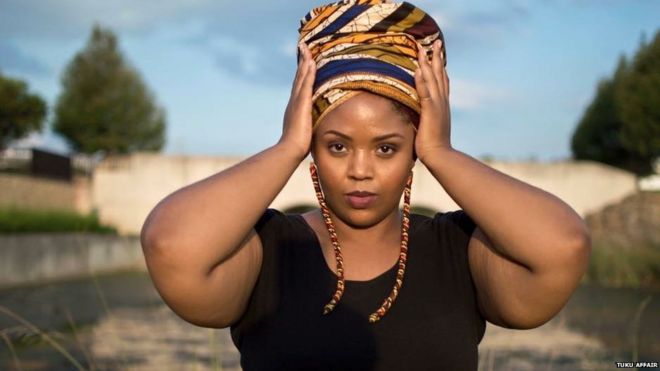
Women in South Africa are often portrayed as strong, decisive and destinated to motherhood.
Gender roles are usually based on several factors such as how the culture has traditionally enacted gender roles through formal (law, policies) and informal institutions (religion, individual and collective beliefs). These roles often persist for generations, because they are an essential part of what defines us as society: our placement in the system and, therefore, our interactions within.
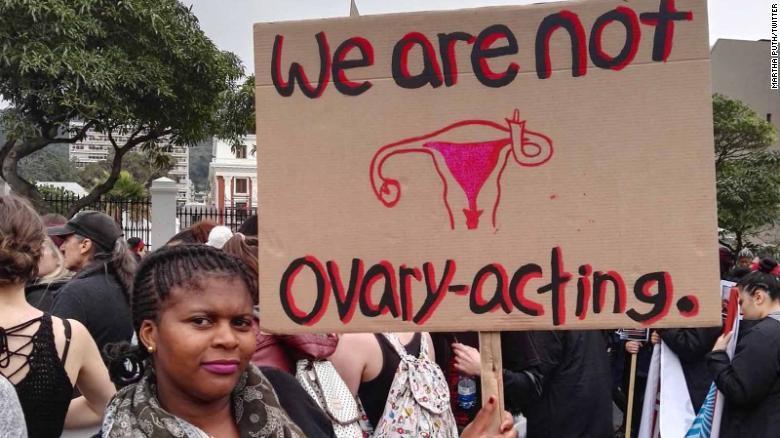
Women movements in South Africa are currently trying to claim their rights in a society that has historically denied them.
In South Africa, many racial and ethnic groups have maintained traditional gender roles, and some of these are very similar to the ones in Colombia, in which women usually have less power than men. Women are also perceived as the weak gender, primarily because these cultures believes we are defined by our emotions and we have no control over them.
Although nowadays men have come to fulfill many women roles, the expectations towards women are higher both in South Africa and Colombia. For instance, women are now expected to work outside, but not stop their domestic job. They get home to cook, clean, get the children ready, among other things.
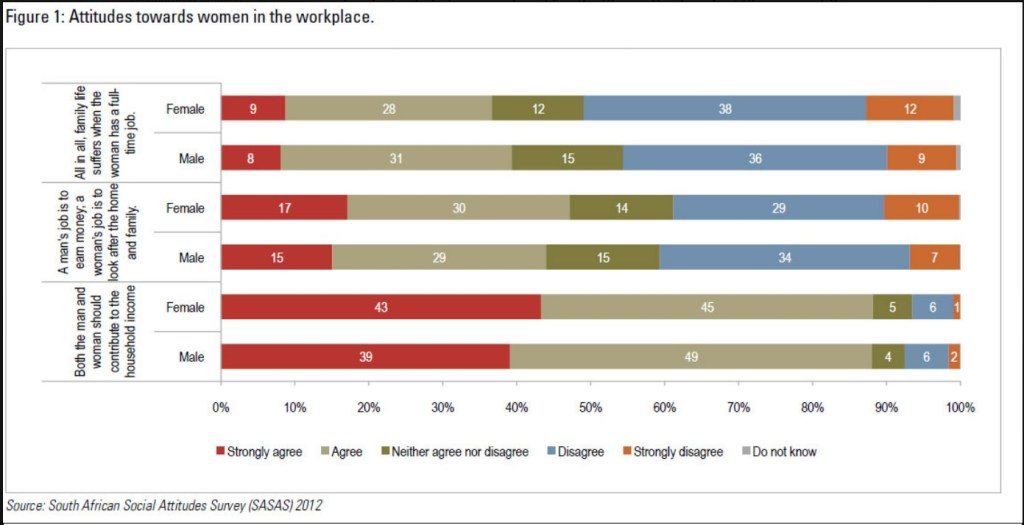
In a study by the Human Sciences Research Council regarding gender roles in South Africa, the burden is unbalanced. Women are expected to take care of their house and also contribute to the welfare of their family. As shown in the figure, the disparity remains even though the conventional model of men as breadwinners and woman charged with raising children and doing household work has begun to change.
The study shows that there was near universal agreement (88%) that both men and women should contribute to the household income, with no gender differences evident in this opinion. But, there’s still a 46% of the adult population that believes that a man’s primary role in the household is to earn money while a woman’s chief role is to look after the home and family, and both men and women were likely to hold this belief. It also shows that less than 40% agrees that family life suffered when the woman had a full-time job. This proves the unbalance between the expectations held for men and women in this Country.
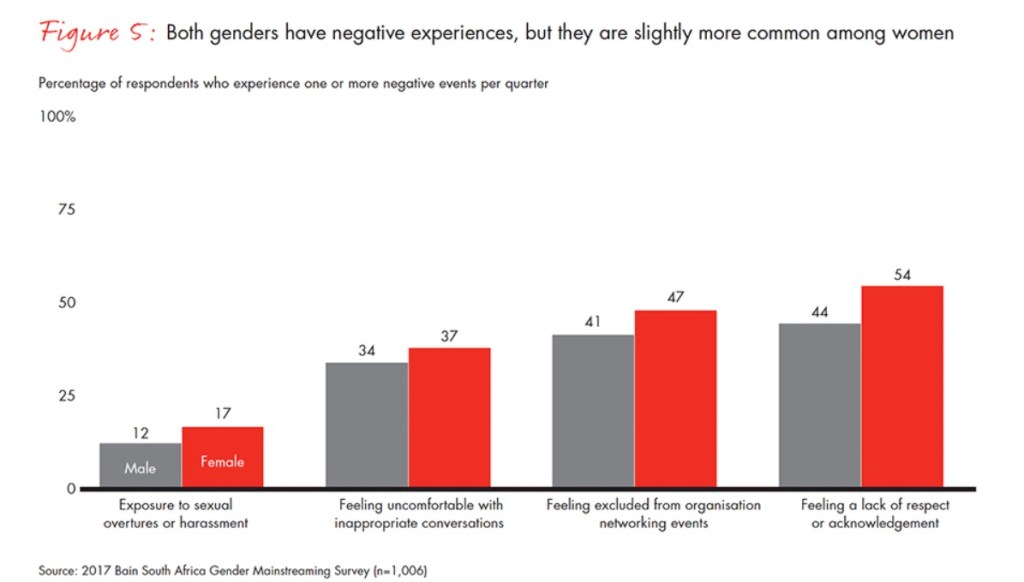
A study by Bain & Company shows that gender roles impact social life in South Africa, resulting in women experiencing more negative events than men (Fajardo and Erasmus, 2017). As shown in the figure, these events also happen to men but on a smaller scale. These results can be felt on other places, including Colombia, where women feel insecure and generally in disadvantage in relation to men.
Also, women make up just over half of the population in South Africa and Colombia, but when one examines the population in the poorest areas like rural areas and informal settlements there are always many more women than men. Over half of all the women that live in these rural areas live in extreme poverty, mainly in single family households. In Colombia, the so called “madres cabeza de hogar” are augmenting. Both here and in South Africa, access to land and support for small-scale farming is a major problem for women. This may be due to the believe that women don’t do well on economics, that this role of owner or producer belongs to men.
One of the differences between South African and Colombian women, is that the latter achieve a higher education level. Most South African women have grade 7 or less education and many no schooling at all. In South African culture, education is often a luxury among people with lower incomes and men are priority because they are more likely to get a job that sustains their family, meanwhile women, because of the roles they’re assigned, are prone to get an underpaid job/position.
Another thing that has impacted South African women is Apartheid. The visible discrimination against black people in this country has caused an even worse condition for black women. In Colombia, there is discrimination but not as radical as in this african country. The Apartheid is still felt in every sphere of life: politics, economy, law and social life. Seeking for a job in South Africa being a woman is harder than in Colombia. In 2017, 31% of South African companies have no female representation in senior leadership roles.
In conclusion, gender roles are still a problem for women in South Africa and in Colombia. In both country, they represent more obstacles in the day-to-day life and also in the long run for women. There are differences, but one can say that men still hold the power in both countries, as women are still considered the “weak gender”.
Welcome to my blog! My name is Carolina Niño, I’m colombian and I’m 21 years old.
I’m studying Social Communication and Journalism in the Universidad del Norte. I find passion in reporting exciting events and being part of new experiences. I’d love to go to South Africa one day and live first-hand all the things I’ve found out about its amazing culture. I cherish travels and new places with all my heart, as I love to know everything that makes a place and its people unique.
I believe culture is a strong tie we have with our roots, I believe it follows us everywhere we go and shapes us in many ways. It builds a part of us that never dies. I, personally, feel so attached to colombian culture, and specifically Barranquilla, that I think everywhere I go I’m carrying a small bag full of my traditions and customs. I take what I feel is good about my culture and I teach it to people from other cultures, and I love to receive the same from them.
It is amazing how much we can learn from different places and find similarities even though we are geographically so far.
Every culture is unique, but I think that we borrow something from each of them and bring it to our own, which means there’s a worldwide culture filled with so many cultures that share different things. I would love to know as many cultures as I can!
Apart from my love to travel, I love eating healthy, exercising, going to farms, being with my friends, going to parties and exploring restaurants. I love to spend quality time with my boyfriend and my family.
I created a textile company with my boyfriend. Our dream is that our brand is recognized worldwide and this allows us to connect with people.
This blog emphasizes the different angles of South African culture, specifically regarding gender roles, cultural behavior, subcultures and tribes! It also shows the differences and similarities between this amazing culture and our own culture: colombian.
My goal is to motivate those who read this to continue learning about this and other cultures, to look beyond the stereotypes and find themselves in a sea of diversity so filled with marvelous things so many people can offer.






 Traveling guide to South Africa