The Lewis Model was developed in the 1990s by Richard D. Lewis after visiting 135 countries and working in more than 20 of them. He came to the conclusion that humans can be divided into 3 clear categories, based not on nationality or religion but on behavior. He named his typologies Linear-active, Multi-active and Reactive.
Lewis considered that other experts (such as Hofstede, Edward Hall, Kluckholn or Trompenaars) overlooked or ignored the powerful Asian mindset (comprising, in fact, half of humanity). He visited many asian countries and decided to locate them in the reactive typology.
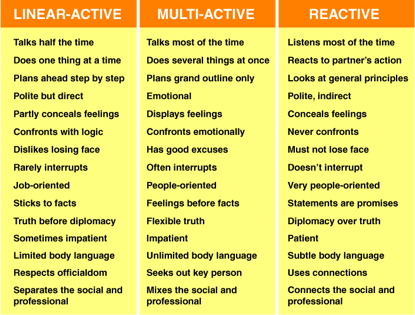
The characteristics of each typology are shown in the chart. The descriptions are clear and succinct. Linear-actives are those who plan, schedule, organize, pursue action chains, do one thing at a time. Multi-actives those lively, loquacious cultures that do many things at once, planning their priorities not according to a time schedule, but according to the relative thrill or importance that each appointment brings with it. And reactives are those cultures that prioritize courtesy and respect, listening quietly and calmly to their interlocutors and reacting carefully to the other side’s proposals.
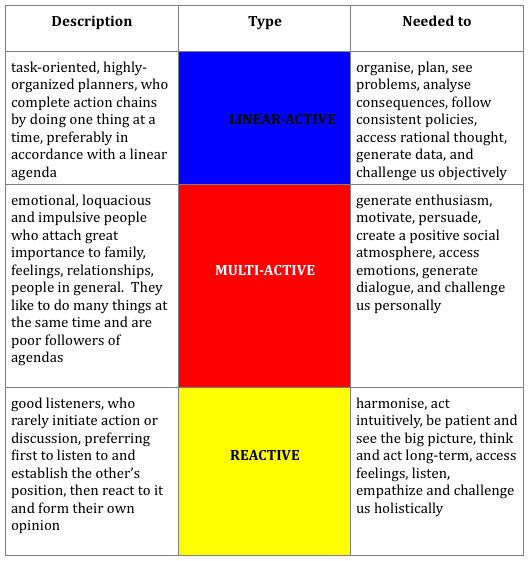
One could say this model allows us to understand our behavior, but mostly our strengths and weaknesses. As we can see in the second chart, the model does not intend to use the typologies to exclude certain cultures but rather take advantage of their strengths, using them wisely. This model is often used in Human Resources because it comprises the factors that must be taken into account for a job. In order to do so, the company can run an individual test to know the affinity of their behaviour with other countries and also their similarity to or deviation from their own national norm. It can also be applied in groups to know compatibility of the people tested.
The comparison
In the following chart is presented the tripartite model, in which can be located both countries that are being analyzed in this blog: Colombia and South Africa.

As it is shown, Colombia is located, next to other south american countries (and Italy) as a multi-active culture, and as the chart specificies it is a warm, emotional, loquacious and impulsive culture. South Africa, on the other hand, is next to Belgium and Israel, right in the middle between the linear-active and multi-active cultures. In order to analyze it we must look into both categories.
Regarding South Africa it is important to keep in mind the lack of data in terms of diversity. In this model the prevalence of white population’s preferences in the results, instead of threating the analysis, reminds us the limits that come with these kind of models, which try to understand behavior as a whole but fail to consider the complications inside a group full of «similar» people.
Having said that, and remembering the descriptions in the previous charts, the analysis is presented in the following chart:
| Colombia | South Africa |
|---|---|
| Displays feelings | Sometimes displays feelings, but mostly conceals them |
| Emotional, loquacious and impulsive, which can be noted in the Hofstede’s model in the indulgence dimension (in which Colombia scored high) | Task-oriented, they tend to organize their job. However they enjoy leissure time and sometimes are impulsive, as they scored high in the indulgence dimension of the Hofstede’s model |
| Great importance to family, feelings, relationships and people in general, noted in the Hofstede’s model in the individualism/collectivism dimension (in which Colombia scored low – collective nation) | Collectivists on a lesser exent but protective of their close ones (families or exclusive groups) |
| Poor agenda followers | Good agenda followers |
It needs to be noted that South Africa is located in the same group as european countries and the United States. This may be to the fact that their culture has been highly westernized and also the prevalence of white population’s preferences in the model. It still reflects the power and influence that its previous colonies had over it.
Hypothetical situation
A person from South Africa that came to Barranquilla would fit well because of the significance that family has for both cultures. However, if this person came to study and would have to do a group project, they would probably face some issues. For instance, Colombia is a multi-active nation, which means we are generally poor followers of agendas so that would be a problem. On the other hand, the fact that South Africans are such good decision makers according to the Lewis Model, would improve the group’s performance.
If this person is someone that does one thing after the other could face limitations as colombians often do many things at the same time. This could be a problem in a group project or even in the classroom, as the techniques used by the teachers are probably influenced by this mindset.
However, it is important to take into account that the model refers mostly to the westernized and white population of South Africa. The circumstances could change if it was someone from a tribe, for example.
In conclusion, the situation wouldn’t be terrible, both cultures are not that different (according to this model). But education styles could be a problem. Given the importance of communication in both cultures, it is surely something that can be talked over.
 Traveling guide to South Africa